


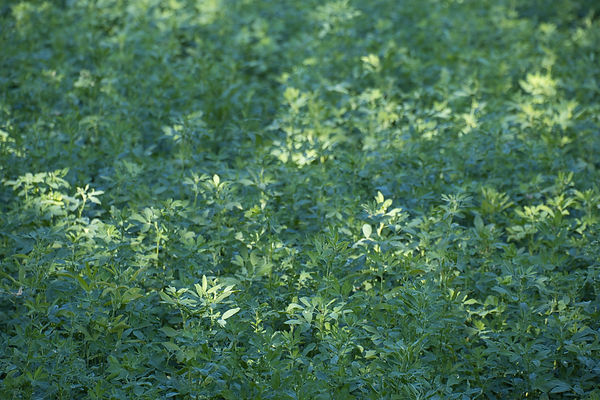
ALFALFA HAY
Scientific Name: Medicago sativa
Common Varieties: There are thousands of varieties.

Crop Information
Alfalfa is a perennial crop, which means it will grow for several years after planting. Alfalfa is planted in
the spring or fall. Since the seeds are so small (1-2 millimeters), slightly wider than the tip of a pencil lead, they must be planted close to the surface of the soil. Between 15-25 pounds of seeds are
planted per acre, which is about the size of a football field. There are about 200,000 alfalfa seeds per pound. After sprouting, the seedlings are relatively weak and must be protected from weeds.
The purple alfalfa flowers are pollinated by bees, whose hives are
placed next to fields that are for alfalfa seed production. Alfalfa is harvested with a swather, which cuts off the crop a few inches above the ground and places it in strips three to five feet wide where it dries in the sun. When the cut alfalfa is dry enough, the hay is raked and a baler is used to gather
it up and compress it into a bale. Bales range in weight from 50 pounds to one ton and usually take the shape of small rectangles that can be managed by one person. Large square or round bales are moved by tractors or “squeezes,”
which are forklifts made specifically for hay. The haymaking
process is highly mechanized, and most hay goes from field to barn without being touched by human hands.
Source: https://alfalfa.ucdavis.edu/-files/pdf/alfalfafactsheet.pdf

Grower Practices
Growers consider soil and water conditions, fertility, and pest pressures to decide economically viable growing practices.

County Statistics
Bearing Acreage: 41,700
Yield Per Acre: 7.11 Tons / Acre
Total Tons: 297,000 Tons
Gross Total Value: $54,968,000
Data Source: San Joaquin County Crop Report, 2020. https://www.sjgov.org/WorkArea//DownloadAsset.aspx?id=33165
Added Value: Essential Food Production, Essential Worker Employment, Education, Research
A food source for dairy cows, beef cattle, sheep, horses, and even zoo animals.
Legumes such as alfalfa convert atmospheric nitrogen into forms that plants can use.
Facilitates soil conservation by reducing soil erosion.
A wildlife habitat for hundreds of animals, including some endangered species.
Lots of open space is created, which provides beauty.
Flowers on the plant make alfalfa honey the main honey crop in the U.S.
A habitat for over 1,000 diverse species of insects, spiders, and mites.

Recipe
Cowboy Beef Stew
Ingredients
2-1/2 pounds beef Stew Meat, cut into 1-inch pieces
1 package (12 to 14 ounces) dried bean soup mix with seasoning packet (not quick cooking)
2 cans (14-1/2 ounces each) diced tomatoes with green peppers and onion
2 tablespoons vegetable oil
1 can (14-1/2 ounces) beef broth
3 cups frozen diced or hash-brown potatoes (optional)
Directions
-
Soak beans in water overnight in refrigerator according to package directions. Reserve seasoning packet.
-
Coat beef Stew Meat with seasoning from reserved packet. Heat 1 tablespoon oil in large stockpot over medium heat until hot. Brown 1/3 of beef; remove from stockpot. Repeat twice with remaining oil and beef, adding additional oil as needed.
-
Pour off drippings; return beef to stockpot. Drain beans; discard water. Add beans, tomatoes and beef broth to stockpot. Bring to a boil. Reduce heat; cover tightly and simmer 1-3/4 to 2-1/4 hours, or until beef is fork tender and beans are soft.
-
Stir in potatoes, if desired; bring to a boil. Reduce heat; continue simmering, uncovered, 5 to 7 minutes or until potatoes are tender, stirring occasionally. Season with salt and pepper, as desired.
Recipe Source: https://www.beefitswhatsfordinner.com/recipes/recipe/1338/cowboy-beef-stew